Thank God it’s Monday, again. I always look forward to every Monday. They’re my 52 Chances a year, in which I get to share Memories of My Mom with you. Therefore, I hope this helps you have a happy Monday, too.
This week celebrates a lot of things. It’s National Gardening Week and this coming Saturday is National Weed Your Garden Day. Plus, it also happens to be National Fresh Fruit and Vegetables Month and National Great Outdoors Month. Incidentally, this past Saturday was National Gardening Exercise Day. Do you see the theme, here?
Gardening is full of gains (or benefits), as it’s mostly an outdoor activity. One such gain is that it’s healthy for us – and that’s in a number of ways, such as exercise and calorie-burning rewards, as well as multi-nutritional values and a lot of essential Vitamin D, which we soak up like a sponge, even when it’s cloudy.
It additionally helps prevent obesity and lowers the risks of high blood pressure, diabetes, and osteoporosis. Moreover, given the cost of groceries these days, there are also financial gains (or savings, as the case may be) from growing a lot of your own food. Furthermore, gardening is known to improve heart and lung health.
Likewise, it stimulates serotonin production in the brain, regulating mood and anxiety. There is growing research on all of the possible gains of gardening for our mental health, emotional health, and physical health.
About the only kind of exercise regimen that I don’t mind doing, besides walking, is gardening; which is classified as a “moderate” exercise (like aerobics) because it works all of the major muscle groups – legs, buttocks, arms, shoulders, neck, back, and abdomen – as you stretch, bend, lift, pull, push, etc. These also build strength and tone muscles.
6 Wonderful Health Benefits of Gardening, on OrganicLesson.com, concurs that gardening strengthens the immune system, relieves stress and elevates happiness; providing a physical workout, while stimulating the brain and encouraging a healthier diet. It also contributes to many important life skills, such as faith, patience, and commitment – even cooking.
According to the editors of Publications International, Ltd., in their article, 20 Everyday Activities and the Calories They Burn (as seen on HowStuffWorks.com), two hours of gardening burns about 648 calories, depending on the tasks performed – planting, weeding, mulching, composting, watering; and repeating it all, daily or weekly, until harvest time.
One hour of gardening and yard work can burn more calories than walking, at a moderate pace, for the same amount of time because it works more muscle groups. According to EnglishGardens.com, based on a 180-lb person, doing various gardening activities for 30 minutes, one can burn the following amount of calories:
- Watering plants, burns 61 calories.
- Planting seedlings, burns 162 calories.
- Weeding, pruning or trimming shrubs (manually), burns 142 calories.
- Composting, digging, spading, or tilling, burns 250 or more calories.
[NOTE: Lighter people usually burn less calories, while heavier people burn more calories.]
There’s also a great calorie-burning chart at NutriStrategy.com, where I found that weeding and cultivating my flower gardens around the house, last week, burned about 393 calories per hour for someone my size.
Homesteading is a style of living that’s focused on self-sufficiency and sustainability – such as growing (and/or raising, as in livestock) your own food, hunting and fishing, canning and preserving, and more. You could say that homesteading has found new life, again. There’s a revival of it, at least in part.
During the last six years, with the continuous rising costs of groceries, many people have resorted to learning many homesteading skills, themselves; such as raising chickens and growing some of their own fresh fruits and vegetables, as well as making their own shelf-stable grocery products and toiletries.
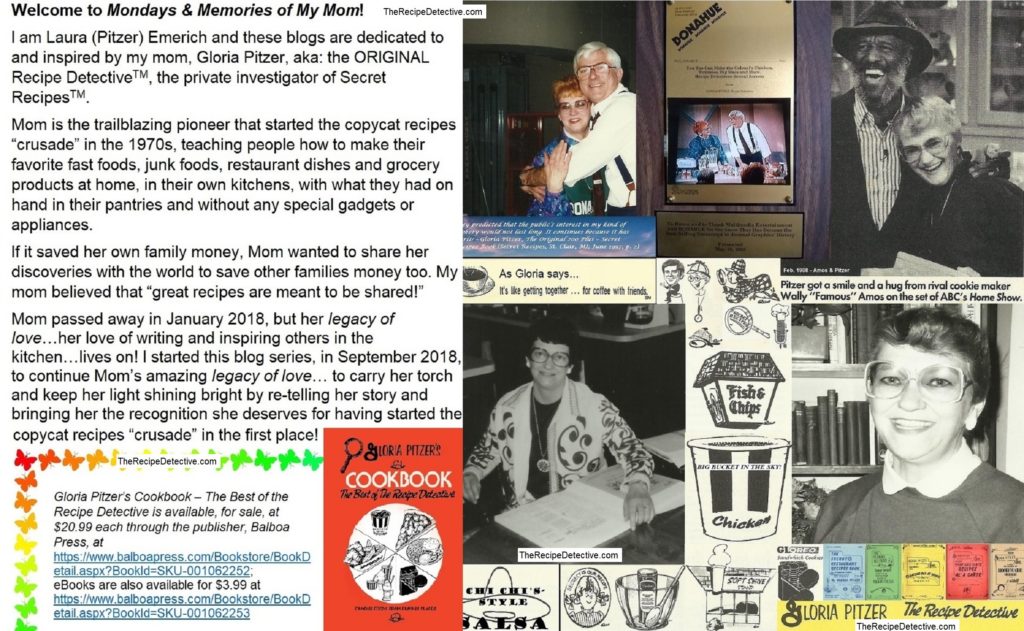
Inflation and the high costs of food is not a new problem. More than 50 years ago, Mom was writing about price increases and a food crisis in her syndicated column, No Laugh ‘N’ Matter, in the early 1970s. Recently, I started sharing one of those columns on the 1st of each month. See the new No Laugh ‘N Matter by Gloria Pitzer tab, for the latest post.
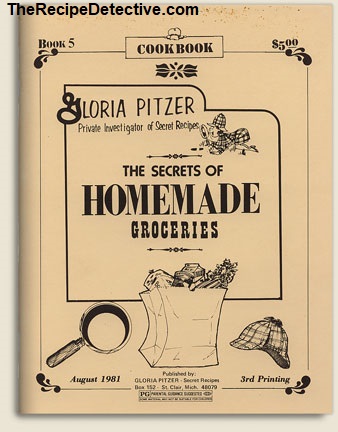
If truth be told, as Mom found, there are so many groceries you can make at home. She featured hundreds of her secret recipes for “homemade versions” of shelf-stable grocery and toiletry products in her self-published cookbook, The Secrets of Homemade Groceries (Gloria Pitzer – Secret RecipesTM, St. Clair, MI; August 1980).
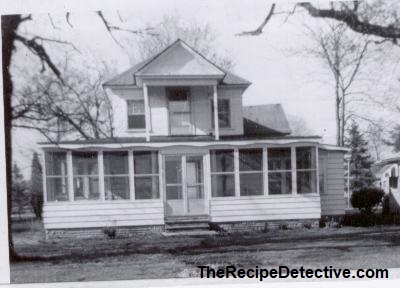
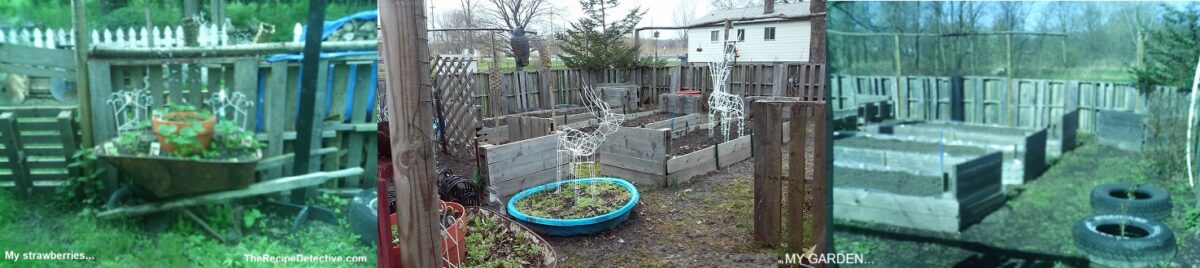
I remember, when we lived in Algonac, she had a raised bed style garden, about 8-ft square. I enjoyed learning how to garden from Mom. I helped her plant and harvest strawberries, cucumbers, tomatoes, and peppers.
I also recall picking wild rhubarb along the driveway’s fence line, as well as apples and pears from our little orchard, with which she created wonderful jams, pies, cobblers, and homemade ice creams. Her Strawberry-Rhubarb Pie (see the “Recipes” tab for her recipe, which I shared a few years ago) was one of my all-time favorites.
[NOTE: Tomorrow is National Strawberry Rhubarb Pie Day.]
Mom picked up a lot of her gardening skills from Dad’s mom, who always had wonderful rose and tomato gardens, when she lived in Detroit. Mom learned a lot about canning from her, too. I remember they used coffee grounds and grounded egg shells in their gardens to help their plants flourish – a family “gardening tip” passed down for generations. I do it, too.
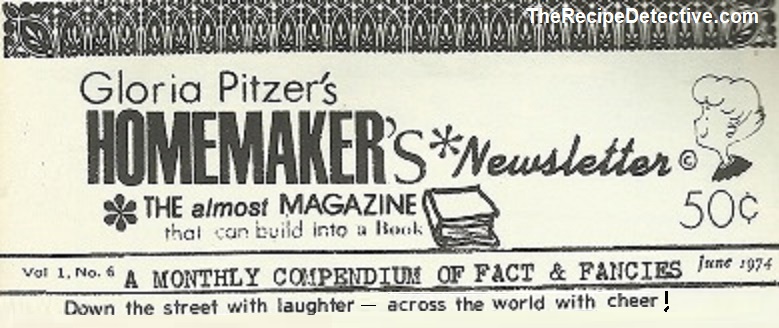
Mom included gardening tips like that in her monthly newsletter, during the first couple years of writing and self-publishing it. Eventually, that “segment” went to the wayside, along with some others, to make more room for her “secret, copycat recipes”.
As the recipe business grew, Mom found she had less and less time to spend on gardening. The high cost of convenience (buying everything at the grocery store) finally out-weighed the value of her time (and energy). Most gardening requires some amount of physical care and continuous dedication of time, to provide such care.
However, these days, people are regaining interest in homesteading – growing and making their own food, as well as DIY health and beauty products. Many have even started small businesses, selling their homemade products online or at farmers’ markets to those who may not have the time or talents for making such things, themselves.

FROM MOM’S MEMORIES…
As seen in…
Gloria Pitzer’s Secret Recipes Newsletter (Secret RecipesTM, Marysville, MI; August 2000, Issue 215, p. 6)
INSPIRATION
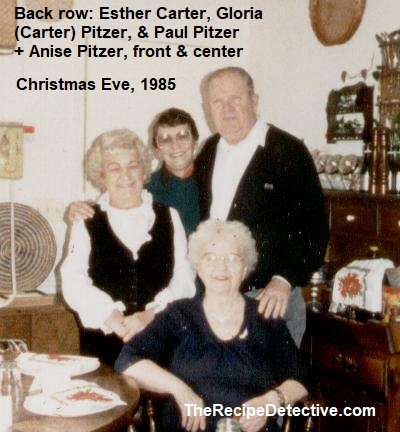
MY OWN INSPIRATION, to become a better cook than I was, came originally from the two most important influences in my young life, my mother and my mother-in-law. From my mom I learned the elegant, artistic presentation of even the most humble leftovers and the joy of making any meal an occasion rather than a ritual.
From my mother-in-law, I learned (while we were living with Paul’s parents), the art of practical food preparations, preserving and canning techniques not always found in the popular cookbooks… How to make your own ingredients when you were out of something.
And so, by combining the lessons learned, from both women, I became an accomplished cook (and much against my better judgement)!
Since then, inspiration has come to me from various other sources, including the big, boring, generic cookbooks. These recipes are always a challenge to try and “Pitzerize”, condensing the lengthy number of ingredients into only a few and arrive at a similar result.
It’s something you will become accustomed to doing once you have used Secret RecipesTM for a while. Whatever requires, for instance, tomato sauce, vinegar, and a little sugar makes use of ketchup, instead – a good replacement of 3 ingredients. Likewise, others will occur to you as you continue to cook. If inspiration doesn’t come to you immediately, give it time and, with practice, I promise it will.
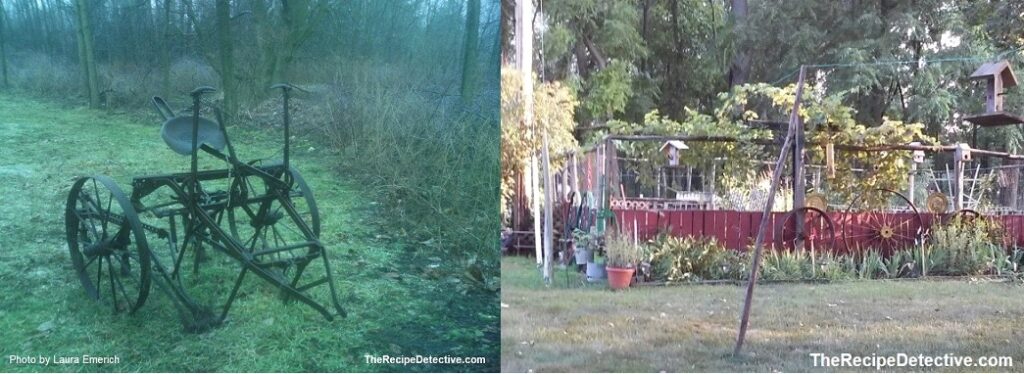
There are many kinds of gardens – flower gardens, including wildlife gardens for butterflies, birds, and bees; as well as ornamental, sensory and fragrance gardens. There’s also vegetable gardens, herb gardens, container gardens, Japanese Zen gardens, and rock gardens. Cottage gardens have a mixture of ornamental flowers, herbs, and vegetables.
June is a great time for getting outdoors and gardening. The weather is getting nicer, and the daylight hours are getting longer. If you don’t have your own garden, or room for one, maybe you can plant a few seeds or seedlings in some patio planters or check your area for a community garden, in which you can contribute and participate.
Before I share with you Mom’s “Gardening Tips” from 1974 (farther below), here’s a re-share of a couple of vegetable gardening lessons I learned online, about 15 years ago (but I can’t remember the website):
- When planting vegetables, some seeds are better to start indoors, like tomatoes, peppers, cauliflower, and broccoli. After 6-8 weeks of growth, the “seedlings” can be transplanted in the garden, when the weather conditions are more optimum for your planting zone.
- Some vegetable seedlings don’t transplant well and should be sown right into the ground, from seed, when weather conditions allow for your planting zone. Examples include corn, beans, and peas. Cover them at night, with a sheet, if frost conditions are possible.
MORE FROM MOM’S MEMORIES…
“Gardening Tips” by Gloria Pitzer, as seen in…
Gloria Pitzer’s Homemaker’s Newsletter (Happy Newspaper Features, Algonac, MI; Vol. 1, No. 6; June 1974, p. 59)
YOUR OWN BACKYARD
“A MIXTURE OF ONE part water, one part citrus flavored soda, and half a teaspoon of chlorine bleach for each quart of solution can help flowers stay fresh longer. The alkalinity of most tap water is neutralized by the citric acid and carbonation in the soft drink. The bleach and carbonation control bacteria that block water flow in the stems. The sugar and soda pop nourishes flowers.”
“Calla lilies are more delicate in appearance than cannas. Plant in sun or in light shade, in pots or in the ground. In the north, lift Calais in the fall and store them in dry vermiculite [for the winter].”
“Peas mature in early summer and don’t like midsummer heat. So, after they’ve finished, one can pull the vines or bushes, dig the space over, feed it, and plant a fall-crop vegetable like broccoli, cauliflower, or Brussels sprouts. Or, if preferred, use the space for lettuce or beans. Brussels sprouts can often be harvested into December.”
“Bonemeal, high in phosphate and containing some nitrogen, will not burn and can be used on bulbs, dahlias, roses, and the like.”
LAST THOUGHTS…
Thanks for visiting! I hope you’ve enjoyed reading about my memories of my mom, her memories, and other related things. If you have any questions or comments, feel free to email me at therecipedetective@outlook.com. You can also find me on Facebook: @TheRecipeDetective. I look forward to hearing from you.
IN CLOSING…
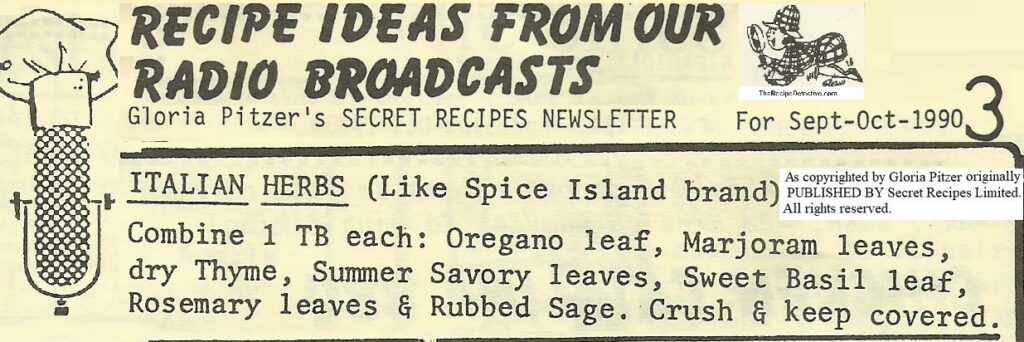
In honor of Wednesday, being National Herbs and Spices Day, here’s Mom’s copycat recipe for “Italian Herbs, Like Spice Island”; as seen in… Gloria Pitzer’s Secret Recipes Newsletter (Secret RecipesTM, St. Clair, MI; Sep.-Oct. 1990, p. 3). As always, I’m asking only for proper credit if you care to re-share it.
P.S. Food-for-thought until next Monday…
The month of June celebrates… National Candy Month, National Camping Month, National Caribbean American Month, National Country Cooking Month, National Dairy Month, National Iced Tea Month, National Papaya Month, National Soul Food Month, National Rose Month, and more.

This week also celebrates… Community Health Improvement Week.
Today is also… National Best Friends Day and National Upsy Daisy Day. Plus, starting the second Monday of June (for five days), it’s also… National Business Etiquette Week (8th-12th, for 2026).
Tomorrow is… National Donald Duck Day.
Wednesday, June 10th, is… National Egg Roll Day, National Ballpoint Pen Day, National Iced Tea Day, and National Black Cow Day.
Thursday, June 11th, is… National Making Life Beautiful Day, National Corn on the Cob Day, and National German Chocolate Cake Day.
Friday, June 12th, is… National Red Rose Day, National Jerky Day, National Peanut Butter Cookie Day, and National Loving Day.
June 13th, is… National Kitchen Klutzes of America Day and National Sewing Machine Day. Plus, as the second Saturday in June (for 2026), it’s also… National Rosé Day.
June 14th, is… U.S. Army Birthday, National Strawberry Shortcake Day, National Flag Day, National Bourbon Day, and National New Mexico Day. Plus, as the second Sunday in June (for 2026), it’s also… National Children’s Day.
Additionally, starting the second Sunday in June through Father’s Day (which is always the 3rd Sunday in June), it’s… Men’s Health Week (14th-21st, for 2026). As the start of the second week in June, it’s also the start of… National Little League Week (14th-20th, for 2026).
Moreover, it’s the start of the week of National Flag Day, which is always June 14th; thus, it’s also the start of… National Flag Week (14th-20th, for 2026).
Have a great week!

…23 down and 29 to go.
