Thank God it’s Monday, again. I always look forward to every Monday. They’re my 52 Chances a year, in which I get to share Memories of My Mom with you. Therefore, have a happy Monday.
Today is the start of the second full business week in May (for 2026), which also makes it the start of… National Etiquette Week and it runs through Friday. Similarly, this Thursday is National Decency Day. “Decency” and “Etiquette” are practically synonymous. Examples include kindness and empathy, as well as considerate and responsible behaviors.
According to Wikipedia.org, Etiquette is a code of ethics or a set of standards for generally acceptable social and personal behaviors that are observed and practiced in polite societies, social classes, and other such groups. In simpler words, etiquette is a guideline of customs for public conduct in a cultured society.
Other synonyms for “etiquette” include protocol, custom, propriety, decorum, politeness, and good manners. Furthermore, “good mannered” includes civil, considerate, cordial, courteous, and gracious, according to Thesaurus.com.
There are many great benefits attained from using proper etiquette, decency, and good manners. It’s known to help build confidence and self-esteem. Plus, knowing how to behave and what’s expected of you in various social situations, produces positive reinforcements from others. Good etiquette is pleasant to be around. It attracts others like a magnet.
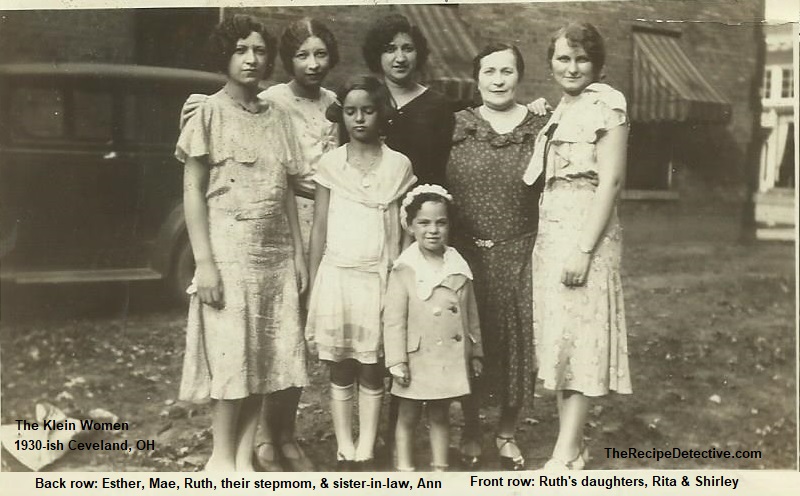
My husband and I were recently discussing how these younger generations, today, seem to be oblivious to good manners, decency, and respect for others. Our parents taught us these simple values, as their parents taught them. We raised our own children in the same manner.
It seems that, somewhere along the way, newer parents have stopped teaching their children these things. I work in retail so I witness it all the time – screaming children demanding their parents buy them whatever they want or they’ll throw temper tantrums beyond belief. It worries me that these kids are our future adults.
Some examples of using proper etiquette include saying things like “please”, “thank you”, “I’m sorry”, and “excuse me”. Good manners also include being punctual, professional, responsive, and respectful; speaking with kindness, honesty, a smile, and eye-contact; as well as giving compliments and avoiding negative remarks or criticisms.
Practice active listening and don’t interrupt others. Open doors for others. Cover your mouth when coughing or sneezing. Dress appropriately. Shake hands/fist-bump in greetings or agreements. Don’t be boastful or arrogant. Respect your elders. Be kind and compassionate. Show appreciation and gratitude. The list goes on and on!
Table manners and meal etiquette are usually different at home than at someone else’s house or out in public. Common expectancies include chewing with your mouth closed; being observant of your surroundings and other people; reading the room and choosing your words/topics wisely, as well as watching your volume. Also avoid using your cell phone.
FROM MOM’S MEMORIES…
As seen in…
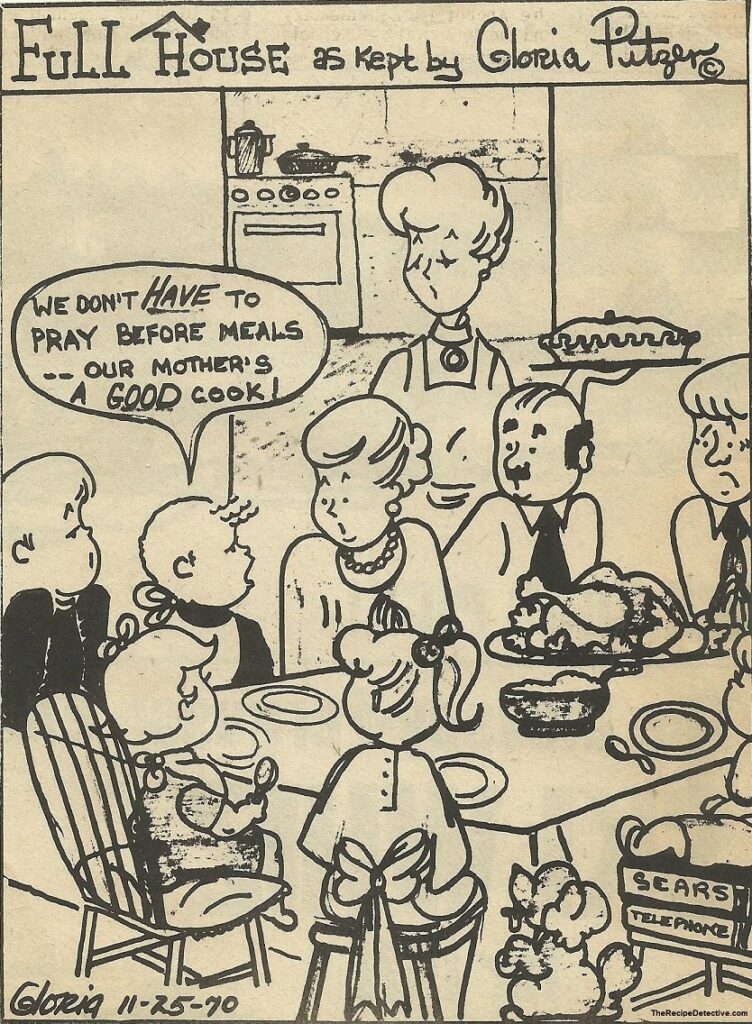
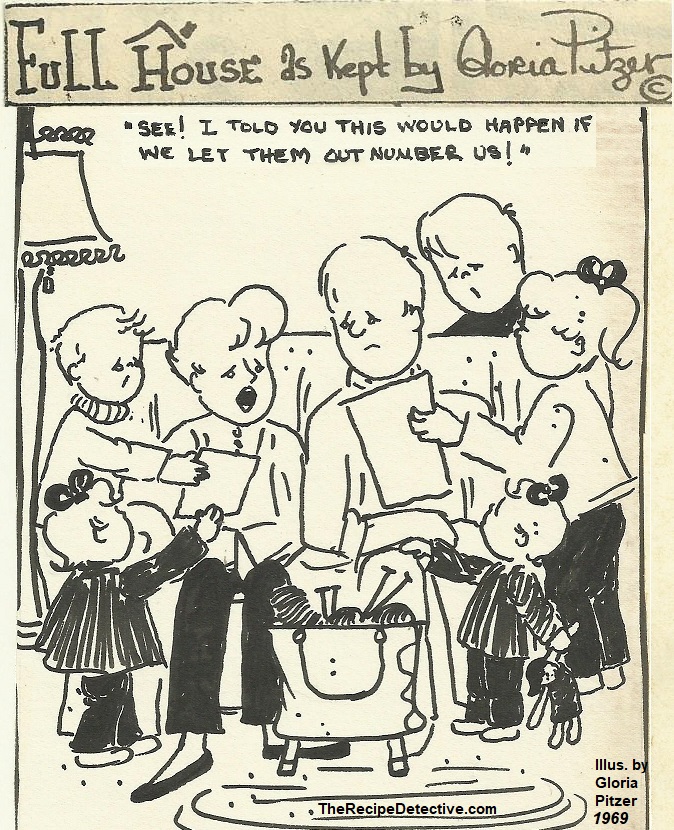
No Laughing Matter, By Gloria Pitzer (Circa 1971)
WHY WASTE ETIQUETTE BOOKS ON ADULTS?
SOMETHING HAS GOT TO be done about etiquette books. All of them seem to be written for grownups. This makes as much sense as sending Twiggy to a sauna bath. The grownups I know have beautiful manners. It’s a joy to be in their company.
On the other hand, how many children are invited to catered [affairs]? Give a grownup a present for his [or her] birthday and he [or she will] be as happy as a hippy with a new string of beads. He [or she] doesn’t burst into tears and declare outrageously: ‘But I already have a Hot Wheels [or Barbie] case!’
Emily Post has wasted her energies on adults. She should have directed her talents to children. We’re all aware of little children’s charms. I have noticed this whenever I take my 4-year old with me.
I have yet to have the produce manager at the ‘A & P’ pat me on the head and offer me an apple. Nor has the bank teller offered me a sucker, only to hear me rapt: ‘But I want a purple one. I hate green!’
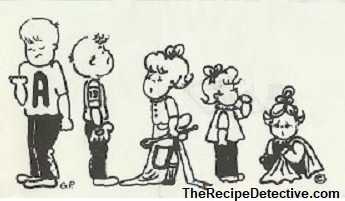
The experts claim children learn by example rather than precept. I wish they would then explain why a child would rather sit ON the table or UNDER it, when parents sit on chairs – with all four legs of that chair on the floor, yet!
Most parents hope to instill in their offspring, during infancy, the simple precept of keeping their fingers out of the Pablum; and accelerate it through teenage adolescence, with more sophisticated postulates of good table manners.
We then hope they come to know that forks are NOT for tapping table legs or catapulting peas off of somebody’s head. Heaven knows we parents try! Yet, children, in spite of their endearing young charms are not socially in demand.
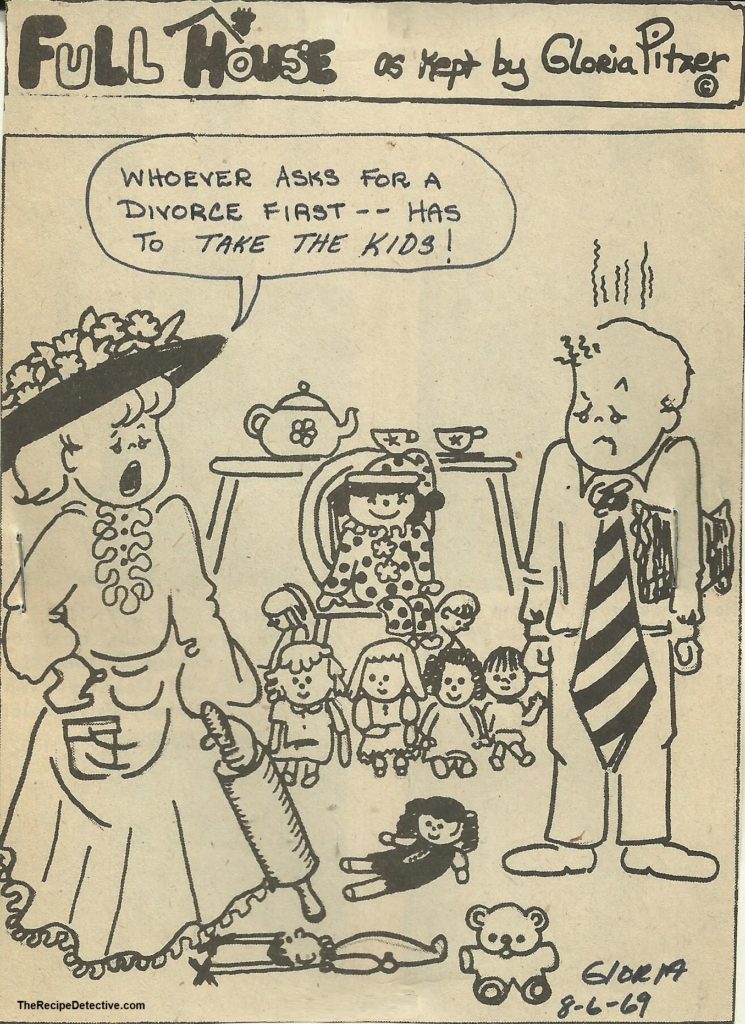
Grandmothers do not invite them to spend the entire summer with them – a weekend, maybe! And you’re not about to serve fondue to them at dinner because, for one thing, little children would rather build something out of their mashed potatoes than eat them.
The trouble with children is they fail to realize that parents are emotionally insecure. And the reason children must be taught to conform to basic social graces is that, someday, they too will be adults. They too will become attached to certain material objects they will respect and cherish and want others to respect and cherish…
Like plants and vases and ball point pens – that bicycles are very expensive and should not be left in the drive-way, where the garbage man might run over them.
A six-year old cannot understand, even though you’ve explained it to her 37 times why she cannot take your silver gravy ladle to the sandbox or your wiglet to ‘show-and-tell’. But just wait until you try to throw out a bald-headed Barbie doll, with a string missing from her back and [only] one leg.
We usually learn etiquette at a young age – from our parents and family, as well as from institutions like schools, churches, and businesses. Our reasoning and civilized behavior are what distinguishes us from animals. Kids are sponges so teach them early about good behavior. It takes a village to set good examples for them to follow.
There’s a variety of “codes of etiquette”, depending on places or events – in a store, school, library, bank, or corporate office. Additionally, during formal/informal “meetings”, at weddings and funerals, while dining out, or when talking on the phone.
There’s also proper etiquette for travel and being on the internet [aka: netiquette]. But etiquette is not written rules or laws with which everyone HAS to comply, or else. However, there are consequences to bad behaviors, while good behaviors are rewarded. When we use good manners, life is simply more pleasant.
MORE FROM MOM’S MEMORIES
As seen in…
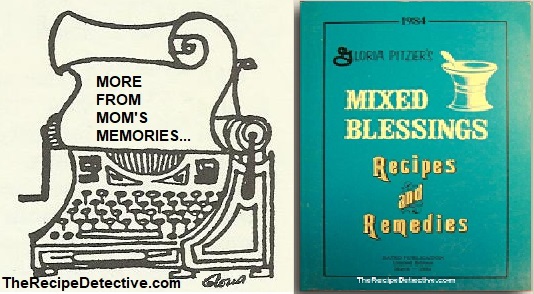
Gloria Pitzer’s Mixed Blessings – Recipes & Remedies (Secret RecipesTM, St. Clair, MI; March 1984, p. 112)
IT’S NICE TO BE NICE
PEOPLE SEEM TO BE very skeptical today about almost everything and every relationship. Life has been hard on most of us, our burdens having been more important to us than we expected, until we can no longer walk away from the habit of concentrating more on the heartaches than on the blessings.
Mixed blessings, perhaps, when you consider how much we all want from life and how little we think we have been given. But nonetheless, blessings are still important to all of us – whether we think we need them or have them or not! They go with the territory! It’s part and parcel of life itself.
As soon, though, as somebody does try to make the situation better by writing a book or a newspaper or magazine article about reviving the decency within our relationships with each other, wouldn’t you know, there’ll be a critic in the end zone, blowing a whistle and calling a penalty against the guy trying to carry the ball.
Today’s crop of critics remain mostly within our media and some within social science community where substance is measured by the amount of what you HAVE, rather than what you are capable of doing and even becoming.
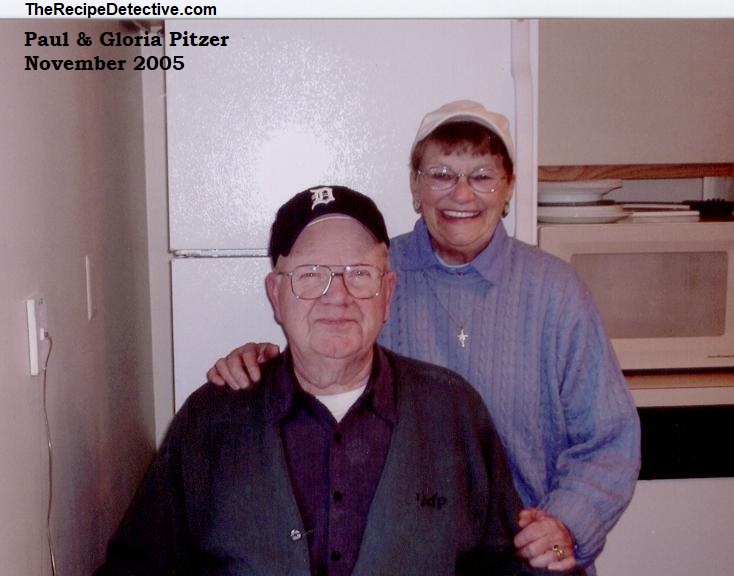
The critics take every chance to discredit the possibility of people caring about each other and not knowing the best way to show they care.
There is always a skeptic ready to renounce any condition that might mean an improvement between people, and with enough criticism, those who do try, usually succumb to the cynics in discouraged retreat.
Loving each other, caring about each other, takes work and we have not been willing nor ready to accept the risk that always goes with loving and working at it, which is necessary to accomplish good relationships between us.
How we feel about a person certainly shapes our views of how they behave it’s like the foreman who was ordered to check up on his best friend was suspected of loafing on-the-job. When he saw the man sitting in the shade, lazily chewing on a toothpick, his report was literally true: ‘I found the man in question, working like a beaver.’
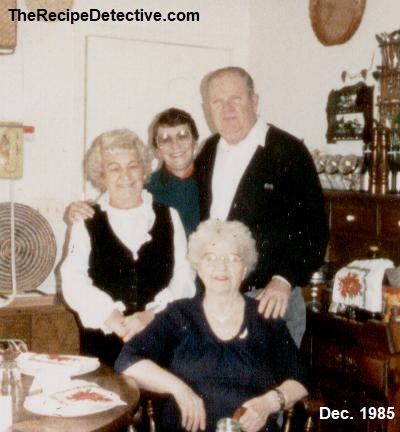
The same thing happens when we discipline our children the degree of what they have done, and how sharply they should be reprimanded is never going to coincide with the opinion of that of their grandmother regarding how we should handle it.
Sometimes I wonder if the reason that we have spoiled kids is due to the fact that we can’t bring ourselves to spank two grandmothers! On the other hand, discipline and guidance is the purpose of parents.
Whenever a child insists they don’t have to be told any longer what to do and how to feel, you can bet they’re more in need of guidance than ever before! Usually they picked out people to be their friends and their models who always feel the rules are written for everyone else but them.
The road to maturity, however, is usually paved with some of the most rugged detours, by which the lessons are learned that resenting authority means you’ll never be wise enough to know how to delegate it, when you’ve never learned how to first accept what is delegated to you.
Authority and responsibility always seem to go hand-in-hand, whether you’re taking it or dishing it out!
“I believe these people agree that there is a greater need to recognize decency and honesty, but in good taste; savoring dependability, unselfishness, compassion and, yes, good manners – all of which are basic to the good life for both the individual and the community.” – Helen Hayes (in a commencement address) [As seen in… This is not a Cook Book! It’s Gloria Pitzer’s Food for Thought (Secret RecipesTM, St. Clair, MI; Oct. 1986, p. 17).]
Have you noticed how much neighboring etiquette has changed over the years? In the past, people used to welcome their new neighbors with homemade casseroles or baked goods, just to introduce themselves and say, “Hi! Welcome to the neighborhood!”
Years ago, neighbors would often offer to help each other. Sometimes they’d stop by for a cup of coffee and small talk, chatting about current events and the like. According to TheSpruce.com, Neighborhood Etiquette used to include sharing things like tools and garden equipment, so everyone didn’t have to go out and buy expensive items that they didn’t often use.
Neighborhood parties and barbecues are becoming long lost traditions, too, as people barely know their neighbors anymore. By the way, Saturday is National Do Something Good for Your Neighbor Day. Let’s get back to being good neighbors!
AGAIN, MORE FROM MOM’S MEMORIES…
As seen in…
This is not a Cook Book! It’s Gloria Pitzer’s Food for Thought (Secret Recipes, St. Clair, MI; Oct. 1986, p. 8)
HAVING A GOOD EXAMPLE
EVERYONE SHOULD HAVE a few good examples to follow at some time in their life. I’m fortunate to have found several… My next door neighbor is one good example to follow.
She’s the one [who’ll] take a cake to a new neighbor, to welcome them. And she’s the one [who’ll] collect for flowers if there’s a death in the neighborhood. She always waves when she sees another neighbor and always smiles. A good example!
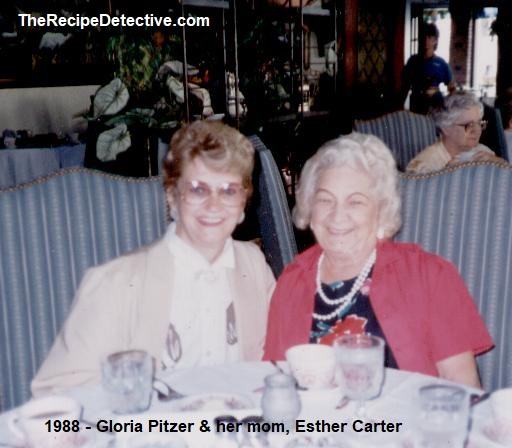
My mother is another good example I’ve followed. Her best gift and her greatest asset is that she’s always been a patient listener and a wise advisor. She was absolutely loyal to my father, through all of his mistakes, in each of his blunders.
The world could turn their backs on her children but she would always be there for [us] when we needed her. She’s given me an example that’s going to be tough to equal. In time though, I hope that I can say I’ve had so many good examples to follow – I’ll try to be one, myself, to somebody else.
LAST THOUGHTS…
Thanks for visiting! I hope you’ve enjoyed reading about my memories of my mom, her memories, and other related things. If you have any questions or comments, feel free to email me at therecipedetective@outlook.com. You can also find me on Facebook: @TheRecipeDetective. I look forward to hearing from you!
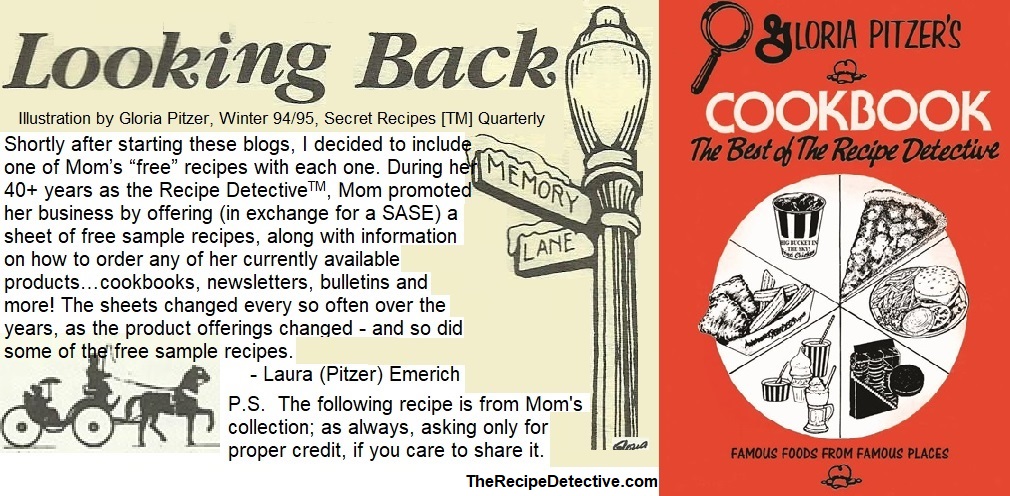
IN CLOSING…
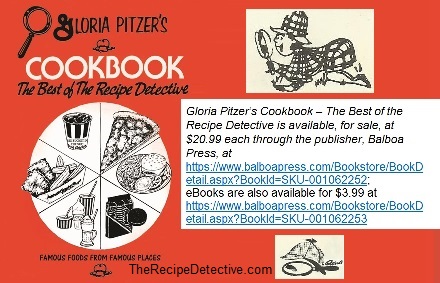
In honor of May, being National Egg Month, here’s TWO of Mom’s copycat recipes for Eggs Benedict & Hollandaise Like Brennan’s; as seen in… Gloria Pitzer’s Cookbook – The Best of the Recipe Detective (Balboa Press; Jan. 2018, p. 136). [A revised reprint of Gloria Pitzer’s Better Cookery Cookbook (Secret RecipesTM, St. Clair, MI; May 1983, 3rd Edition)]. As always, I’m asking only for proper credit if you care to re-share them.

P.S. Food-for-thought until next Monday…
The month of May celebrates… American Cheese Month, Better Speech and Language Month, National Asparagus Month, National Stroke Awareness Month, Older Americans Month, National Barbecue Month, National Get Caught Reading Month, National Hamburger Month, National Photography Month, National Preservation Month, National Recommitment Month, National Salad Month, National Salsa Month, National Strawberry Month, Asian American and Pacific Islander Heritage Month, and more.

This week celebrates… Bike to Work Week, which is always the week that includes the 3rd Friday in May.
Today is also… National Eat What You Want Day and National Foam Rolling Day.
Tomorrow is… National Nutty Fudge Day.
Wednesday, May 13th, is… National Crouton Day, National Apple Pie Day, and National Fruit Cocktail Day.
Thursday, May 14th, is… National Buttermilk Biscuit Day.
May 15th is… National Chocolate Chip Day. Plus, as the 3rd Friday in May (for 2026), it’s also… National Pizza Party Day and National Bike to Work Day.
May 16th is… National Barbecue Day, National Love a Tree Day, and National Mimosa Day. Plus, as the 3rd Saturday in May (for 2026), it’s also… National Armed Forces Day and National Learn to Swim Day.
Sunday, May 17th, is… National Pack Rat Day, National Cherry Cobbler Day, National Walnut Day, and National Idaho Day.
Have a great week!
…19 down, 33 to go.
